PPE field note
What Are Safety Glasses? The Question I Stopped Asking After a $3,200 Eye Injury
Posted on 2026-08-12 by Jane Smith
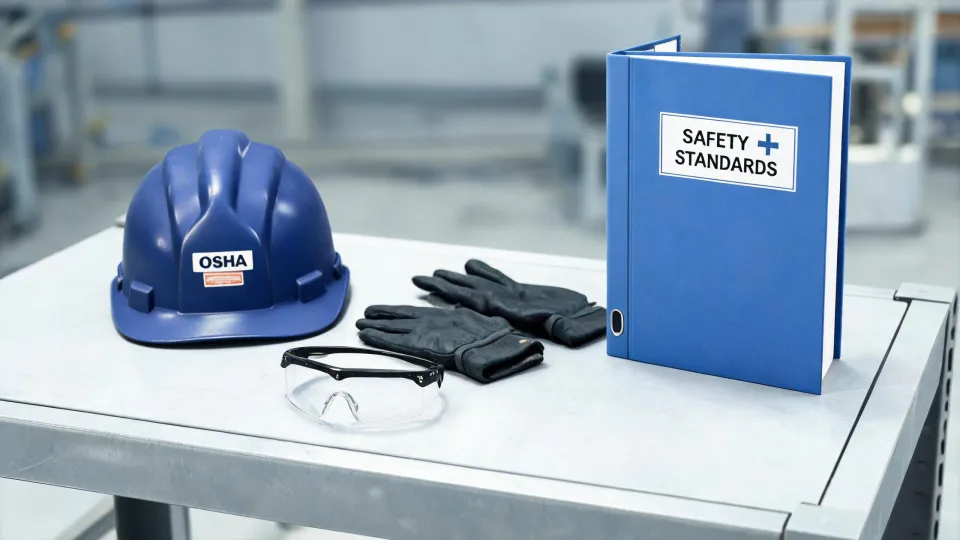
If you've ever typed "what are safety glasses" into a search bar, I get it. I used to think the answer was simple: a frame, a lens, a way to stop projectiles—or rather, a product you buy from a catalog and hand to a crew. Then eight years of ordering PPE for construction crews taught me otherwise.
I'm not a safety engineer. I'm the person who handles PPE orders for a regional construction operation. I've personally made (and documented) 14 significant mistakes, totaling roughly $18,600 in wasted budget. Now I maintain our team's PPE checklist so nobody has to repeat my errors.
The surface problem: what are safety glasses, really?
The honest answer is that "safety glasses" is a technical category, not a look. OSHA's eye protection standard (29 CFR 1910.133) requires employers to make sure workers use appropriate eye protection when there is a reasonable possibility of injury. The commonly accepted performance benchmark is ANSI/ISEA Z87.1. A pair marked with Z87 meets the basic impact test. A pair marked Z87+ has passed high-velocity impact testing.
That matters. And most buyers still miss it.
The question everyone asks is: "Are these impact rated?" The question they should ask is: "Will this crew actually keep them on their face?" I learned that difference the expensive way.
The deep cause: we treat eye protection as a disposable commodity
In my first year (2017), I made the classic mistake. I bought 250 pairs of $2.10 "safety glasses" from a marketplace listing because the budget was tight. The photo looked fine. The title said safety glasses. The box arrived with no ANSI marking, no Z87 stamp, and a lens so soft I could bend it with my fingers.
We had to throw away the entire order. The $525 in glasses was bad enough. The expedited replacement shipped overnight cost another $365. Total: $890 wasted, plus a week of crews working with whatever sunglasses they had in their trucks. That error taught me a simple rule: if the manufacturer won't put a standard on the product, the product isn't standards-compliant.
But the deeper issue wasn't the order. It was how we thought about the category.
Safety glasses are not a commodity. They're a piece of equipment with a job to do. When you treat them like cheap giveaways, you teach workers to treat them that way too.
The fogging problem made it real
The worst incident happened in September 2022. One of our crews was building a cedar fence around a pump station. They spent the morning cutting cedar fence pickets and then moved to drilling holes in a metal fence line overhead. A guy took off his safety glasses because they fogged up every time he bent over. He put them on the truck seat and worked for maybe twenty minutes without them.
It wasn't a piece of metal that got him. It was a small splinter of cedar that flicked off a picket and caught his eye. Corneal abrasion. The medical visit, the downtime, and the rescheduling on that job cost us about $3,200. The guy was lucky—he still has full vision. But the incident went on the loss report, and I had to explain to the client why a small fence job turned into a three-day delay.
That's when I stopped asking "what are safety glasses" and started asking "what makes glasses wearable enough that a tired worker won't take them off?"
The cost of getting it wrong goes far beyond the price tag
I could walk you through all 14 mistakes, but they all point in the same direction. Cheap, unmarked glasses. Glasses without anti-fog treatment. Glasses that pinch under hearing protection. Glasses ordered in one size because nobody asked the crew. A missing Z87 marking is a red flag, no matter how good the price is.
There's also the quality-perception problem. When a client walks a job site and sees scratched, fogged, bargain-bin eyewear lying on a truck dashboard, they make a judgment about the entire company. The work might be clean. The metal fence might be straight. The fine details in a cedar fence might be perfect. But the impression stuck in the client's head is the cheap glasses and the unprofessional look.
That's not a small thing. In our world, the way a crew looks on site is part of the product they're selling. If the PPE looks like an afterthought, clients assume the safety culture is an afterthought too.
This is where I stopped trying to save two dollars per pair and started paying attention to who we bought from. If you search "magid-glove" the way I did, you'll see how many suppliers claim to be the same. I needed someone who could verify a product number, not just take an order.
Magid Glove and Safety Manufacturing Company LLC had been on our approved vendor list for years, mostly for work gloves. When I finally called them about eye protection, the conversation changed how I spec PPE. They could tell me exactly what the Magid Glove & Safety GPD700-10 was designed for, which hazards it addressed, and why the product number existed at all. That level of detail is rare, and it's exactly the kind of thing that keeps a procurement team from accidentally ordering a box of unmarked junk.
Also, if a supplier says "shatterproof" in the title, remember the FTC (ftc.gov) requires advertising claims to be truthful and substantiated. But the real performance promise comes from the ANSI mark, not the sales copy.
What I learned about being a buyer
I used to see safety glasses as an expense line. Now I see them as a brand line. The $50 difference per case between a cheap pair and a decent pair translates into workers who wear them, fewer incidents, and a client who sees a crew that looks like they know what they're doing. Not every pair has to be the most expensive option. But it does have to be the right tool for the task, and it has to be a pair your workers don't want to take off.
Oh, and never buy anything with "safety glasses" in the title unless the lens and the frame both carry the standard mark. Trust me on this one: a fogged lens ends up on a dashboard.
The short version: what actually works
I'm going to keep this brief because the problem is the real story. The solution is almost boring:
- Spec to ANSI Z87.1 at minimum, Z87+ when there's any impact risk. That includes grinding, sawing, and overhead work. It includes installing metal fence posts and cutting cedar fence pickets.
- Test glasses with the actual crew before buying in bulk. We keep a "fit rack" with six different styles. If workers take them off during the trial, we don't order them. Fogging is a deal-breaker, no matter how nice the frame looks.
- Buy from a supplier who can answer product-level questions. For us, that often means Magid Glove. Ask about anti-fog coatings, replacement parts, and whether the model is actually designed for the task you have in mind.
- Inspect and replace. We run a ten-second check for the Z87 mark, scratches, broken temples, and worn coatings. In the past 18 months, this checklist has caught 47 potential issues before they made it to a jobsite.
Bottom line: safety glasses are a piece of personal protective equipment that only works if someone actually wears them. The cheapest pair in the catalog is no bargain if it stays in the truck.
This reflects what I learned through early 2025. OSHA requirements and ANSI standards can change, and new lens technologies keep showing up. Verify the current standard before you place any order.
So if you're searching "what are safety glasses," you're asking a reasonable question. But the better question is: how do you get a tired, busy worker to keep an approved pair on their face while they're doing dangerous work? Answer that, and the rest is just paperwork.

Jane Smith
I’m Jane Smith, a senior content writer with over 15 years of experience in the packaging and printing industry. I specialize in writing about the latest trends, technologies, and best practices in packaging design, sustainability, and printing techniques. My goal is to help businesses understand complex printing processes and design solutions that enhance both product packaging and brand visibility.
Leave a Reply